Aluminum is often the first material engineers consider when a CNC part needs low weight, clean machining, corrosion resistance, and a professional surface finish. It is not the right answer for every component, but for housings, brackets, audio parts, drone structures, robotics components, fixtures, heat-dissipation parts, and prototypes, aluminum gives designers a rare balance: it is light enough for performance-driven products, strong enough for many mechanical assemblies, and efficient enough for CNC shops to machine at competitive lead times.
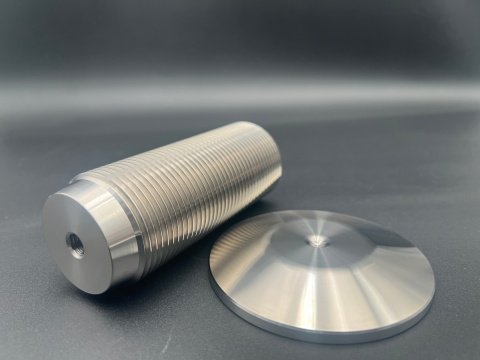
For buyers comparing steel, brass, plastics, titanium, and aluminum, the real question is not simply “is aluminum strong?” The better question is: does aluminum give the best strength-to-weight, machinability, finish, and total cost for this specific CNC part? In many product-development cases, the answer is yes.
Quick Answer: Why Aluminum Works So Well For CNC Machining
Aluminum is a strong CNC machining choice because it removes material efficiently, produces good surface quality, supports tight dimensional control when the process is stable, and accepts finishes such as anodizing, bead blasting, polishing, and powder coating. Common grades such as 6061-T6 and 7075-T6 also offer useful mechanical properties without the density penalty of steel.
For example, aluminum has a typical density around 2,700 kg/m3, while steel is commonly listed around 7,850 kg/m3 in engineering reference tables. That means an aluminum part with the same volume can weigh about 66% less than steel before geometry changes are even considered. For CNC components used in motion systems, handheld devices, aerospace-style assemblies, audio hardware, and electric vehicles, that weight saving can directly improve performance.
Internal resources:
- Learn more about our aluminum CNC machining capabilities.
- Review our CNC milling services for precision pockets, profiles, brackets, housings, and plates.
- Explore CNC turning services for shafts, bushings, rings, spacers, and threaded aluminum parts.
1. Aluminum Has An Excellent Strength-To-Weight Ratio
Weight reduction is one of the clearest reasons to choose aluminum material for CNC machining. In many assemblies, a lighter part reduces inertia, improves handling, lowers shipping weight, and helps designers meet packaging or motion-control targets.
This is especially useful for:
- Drone frames, UAV brackets, and lightweight fasteners
- Robotics arms, grippers, motor mounts, and end-effectors
- Audio components and visible hardware where low mass and clean appearance both matter
- Automotive and EV brackets, housings, and thermal components
- Portable medical, optical, and electronics enclosures
- Test fixtures and prototype structures that must be moved or adjusted often
The advantage becomes more important when the part is not only static but moving. A steel bracket may be stronger in absolute terms, but if the design target is lower inertia or easier acceleration, aluminum can deliver enough strength with much less mass.
2. 6061 Aluminum Is A Practical Default For CNC Parts
For general CNC machining, 6061-T6 aluminum is often the practical starting point. It machines cleanly, is widely available, responds well to anodizing, and offers a dependable mix of strength, corrosion resistance, weldability, and cost.
Published material references commonly list 6061 aluminum with a density of about 2.70 g/cm3. AZoM’s 6061 alloy data also lists representative 6061-T6 tensile strength around 310 MPa, with mechanical values depending on product form and temper. These numbers make 6061-T6 suitable for many machined housings, plates, brackets, covers, adapters, and general-purpose structural parts.
Choose 6061 aluminum when you need:
- A balanced material for prototypes and production parts
- Good CNC machinability and predictable sourcing
- Better corrosion resistance than many high-strength aluminum grades
- Good anodizing response for cosmetic or protective surfaces
- A sensible cost-performance ratio for everyday machined components
For many projects, 6061-T6 is not chosen because it is the strongest aluminum. It is chosen because it is reliable, available, affordable, and easy to manufacture well.
3. 7075 Aluminum Provides Higher Strength For Demanding Parts
When the part needs higher mechanical strength, 7075-T6 aluminum becomes a strong candidate. Xometry’s 7075 material guide lists upper-range tensile strength for 7075-T6/T651 around 570 MPa, which is much higher than typical 6061-T6 values. That is why 7075 is common in aerospace-style structures, UAV components, high-load brackets, bicycle parts, and performance hardware.
However, 7075 is not automatically better than 6061. It is typically more expensive, less corrosion-resistant than 6061, and less weld-friendly. In CNC machining, it can be an excellent material when high strength and low weight matter more than maximum corrosion resistance or lowest raw material cost.
Choose 7075 aluminum when the project requires:
- Higher strength-to-weight performance
- Thin-wall parts that must remain mechanically capable
- Aerospace-style brackets, drone parts, or structural hardware
- High-performance consumer, robotics, or mobility components
- A material upgrade from 6061 without jumping to titanium or steel
For a real lightweight structural context, see our related case study on 7075 aluminum UAV parts for a Canadian drone startup.
4. Aluminum Machines Faster Than Many Harder Metals
Aluminum is generally easier to cut than stainless steel, titanium, and many nickel alloys. That matters because CNC machining cost is not only material price; it also includes cycle time, tool wear, setup strategy, inspection time, and finishing.
In production terms, aluminum can support:
- Higher spindle speeds and feed rates when tooling and workholding are correct
- Lower cutting forces than many steels
- Reduced tool wear compared with abrasive or work-hardening materials
- Cleaner chip evacuation with the right cutter geometry and coolant strategy
- Good surface finish directly from machining when parameters are stable
This is one reason aluminum is widely used for rapid prototypes. Engineers can test geometry in real metal without the time and cost burden of harder materials. When the final part also benefits from low weight and corrosion resistance, the prototype material can often become the production material too.
5. Aluminum Supports Excellent Surface Finishes
Aluminum is one of the most finish-friendly CNC materials. A machined aluminum part can be left as-machined for functional surfaces, bead blasted for a uniform matte look, polished for reflectivity, or anodized for corrosion resistance and color.
Common aluminum finishing options include:
- As-machined: good for functional prototypes, internal parts, fixtures, and surfaces where tool marks are acceptable.
- Bead blasting: creates a consistent satin texture and hides minor machining patterns.
- Anodizing: improves corrosion and wear resistance while allowing clear, black, red, blue, gold, or custom appearance targets.
- Hardcoat anodizing: increases surface hardness for wear-prone parts.
- Powder coating: useful for durable colored exterior parts and enclosures.
- Polishing: selected for visible decorative or optical-adjacent components.
If appearance matters, finish planning should begin before machining. Cosmetic faces, fixture marks, sharp edges, tool access, and anodizing rack points all affect the final result. For visible parts, our anodizing services and broader surface finishing services can be reviewed during RFQ so the machining strategy matches the finish requirement.
6. Aluminum Offers Useful Thermal Conductivity
Aluminum is also useful when a CNC part must move heat. AZoM lists thermal conductivity for 6061 aluminum around 167 W/m·K, depending on temper and condition. That is one reason aluminum is common in heat sinks, LED housings, electronics enclosures, motor covers, and audio components where heat dissipation and weight both matter.
Thermal performance is not only about the material. Geometry matters too. CNC machining allows engineers to add fins, ribs, pockets, contact pads, threaded inserts, and mounting details in one controlled manufacturing process. Compared with many plastics, aluminum gives much better heat spreading while still remaining easier to machine than copper for many structural designs.
7. Aluminum Can Reduce Total Project Cost
Aluminum is not always the cheapest raw material by kilogram, but CNC part cost is rarely decided by raw material alone. A well-designed aluminum part can reduce total cost through faster machining, fewer tool changes, shorter finishing routes, lower shipping weight, and easier assembly.
Cost advantages often appear when:
- The part has large pockets or high material-removal volume
- The part needs a visible surface finish but not stainless steel corrosion performance
- Weight reduction lowers assembly or logistics cost
- The project needs prototypes quickly before production tooling decisions
- The same supplier can handle machining, finishing, and inspection together
To estimate cost accurately, provide CAD files, 2D drawings, tolerance notes, surface finish requirements, quantity, and any cosmetic face requirements. Our engineers can then review whether 6061, 7075, 2024, 5052, or another grade is the most practical choice.
8. Aluminum Is Highly Recyclable
Sustainability is another reason aluminum remains important in modern manufacturing. The Aluminum Association notes that around 75% of all aluminum ever produced is still in use today, and that aluminum is one of the most recycled and recyclable materials in use. For companies with environmental reporting targets or circular material strategies, aluminum can be a practical choice because it can be recycled repeatedly without losing its core metal identity.
This does not mean every aluminum CNC part is automatically low-impact. The actual footprint depends on alloy source, recycled content, machining yield, logistics, finishing chemistry, and end-of-life recovery. But compared with many material systems, aluminum offers a strong path for reuse and recycling.
9. When Aluminum Is Not The Best CNC Material
Aluminum is versatile, but it is not universal. A stronger, harder, hotter, or more chemically resistant material may be better when the part faces severe loads, abrasion, high temperatures, aggressive chemicals, or threaded wear.
Consider alternatives when:
- The part needs very high stiffness in a compact geometry
- Threads will be assembled and disassembled repeatedly under high load
- The operating temperature may reduce aluminum’s mechanical performance
- The part needs extreme wear resistance without inserts or surface treatment
- The environment requires stainless steel, titanium, or nickel alloy corrosion performance
In these cases, aluminum may still be useful with design changes, hardcoat anodizing, steel inserts, bushings, or larger cross-sections. But the material decision should be made from operating conditions, not just from machining convenience.
Aluminum CNC Machining Material Selection Table
| Material choice | Best for | Main caution |
|---|---|---|
| 6061-T6 aluminum | General CNC parts, housings, brackets, prototypes, anodized parts | Not as strong as 7075 |
| 7075-T6 aluminum | High-strength lightweight components, UAV parts, performance hardware | Higher cost and lower corrosion resistance than 6061 |
| 2024 aluminum | Fatigue-sensitive aerospace-style components | Corrosion protection often needed |
| 5052 aluminum | Sheet metal parts, covers, panels, formed components | Not ideal for all high-precision milled features |
| Steel | High stiffness, wear, threads, heavy-duty structures | Much heavier than aluminum |
| Titanium | High strength, corrosion resistance, low density versus steel | Higher machining cost and longer lead time |
Design Tips For Aluminum CNC Machined Parts
To get the best result from aluminum CNC machining, design the part for both function and manufacturability.
Practical tips:
- Avoid unnecessarily tight tolerances on non-critical features.
- Use generous internal radii where possible to reduce tool stress and cycle time.
- Identify cosmetic faces clearly on the drawing.
- Decide whether threads need inserts for repeated assembly.
- Add flat, stable datum surfaces for inspection and fixturing.
- Discuss anodizing before finalizing dimensions, because coating thickness can affect fits.
- For thin-wall parts, allow machining strategy and stock condition to control distortion.
The earlier these details are discussed, the easier it is to prevent cost increases and dimensional surprises.
FAQ: Aluminum Material For CNC Machining
Is aluminum good for CNC machining?
Yes. Aluminum is one of the most commonly selected CNC machining materials because it cuts efficiently, supports good surface finish, offers useful strength-to-weight performance, and works well for prototypes and production parts.
Which aluminum is best for CNC machining?
6061-T6 is often the best all-around choice for CNC machining. 7075-T6 is better when higher strength is required, while 5052 is more common for sheet metal parts than complex milled components.
Is 6061 or 7075 better for CNC parts?
6061 is usually better for general-purpose parts, anodized cosmetic components, and cost-sensitive work. 7075 is better for high-strength lightweight parts where performance matters more than material cost and corrosion resistance.
Can aluminum CNC parts be anodized?
Yes. Aluminum is highly suitable for anodizing. Clear, black, colored, and hardcoat anodizing are common options, depending on appearance, corrosion resistance, and wear requirements.
Is aluminum cheaper to machine than steel?
Often, yes. Aluminum can usually be machined faster than steel and with lower cutting forces. However, final cost depends on alloy grade, part geometry, tolerances, finish, quantity, and inspection requirements.
Conclusion: Choose Aluminum When Weight, Speed, Finish, And Cost Need To Work Together
Aluminum is a strong CNC machining material because it solves several engineering problems at the same time. It reduces weight, machines efficiently, supports attractive finishes, offers useful corrosion resistance, and provides practical alloy choices from general-purpose 6061 to high-strength 7075.
If your project involves aluminum housings, brackets, audio parts, robotic components, drone structures, heat-dissipation parts, or precision prototypes, Huade can help review the drawing, recommend the right alloy, and plan the machining and finishing route. Start with our aluminum CNC machining service, or send your RFQ with CAD files, quantity, tolerance requirements, and finish expectations.