If you are sourcing a prismatic bracket, housing, plate, or enclosure, 3-axis CNC machining is probably the most familiar manufacturing route in your RFQ stack. In 2026, it is also one of the most standardized. The machines are common, the process logic is mature, and the real cost difference no longer comes from exotic technology. It comes from how well the part fits the logic of subtractive manufacturing.
That is the core idea behind this guide: if a design is friendly to 3-axis machining, the quote becomes simple, stable, and scalable. If the design forces multiple flips, deep pockets, and overly tight cosmetic callouts, the cost climbs quickly.
For buyers and engineers, the good news is that 3-axis cost is highly controllable. In many cases, a few drawing changes can reduce a quote by 10 to 30 percent without changing the function of the part. If you are comparing capabilities, you can also review Huade’s CNC milling service, aluminum CNC machining, surface finishing services, and quality control capability.
1. Introduction: The Commodity of 3-Axis Machining in 2026
3-axis machining in 2026 is no longer a mysterious custom service. It is a standard industrial process used to turn CAD geometry into repeatable parts at a predictable cost. The machines are common, the workflows are well understood, and most serious suppliers can quote simple or medium-complexity parts with confidence.
That is why the biggest cost gap is no longer “which factory is cheapest.” The bigger question is “which design is more aligned with 3-axis logic.”
In other words, the buyer who wins is usually the one who gives the machine an easy job.
At Huade Precision, we see this every day in Dongguan. Our advantage is not built on a magic machine. It comes from a dense manufacturing ecosystem: material supply, finishing partners, inspection support, and fast handoff between engineering and production. That is especially helpful for aluminum parts that may need anodizing, black oxide, passivation, or fast inspection after machining.
For many buyers, this is where cost planning starts to make sense:
- Simple geometry plus realistic tolerances usually means a lean quote.
- Multiple setups, deep cavities, and slow finishing often mean a higher quote.
- Better DFM usually means a better price without sacrificing function.
2. 2026 Global Cost Benchmarks: 3-Axis CNC Hourly Rates
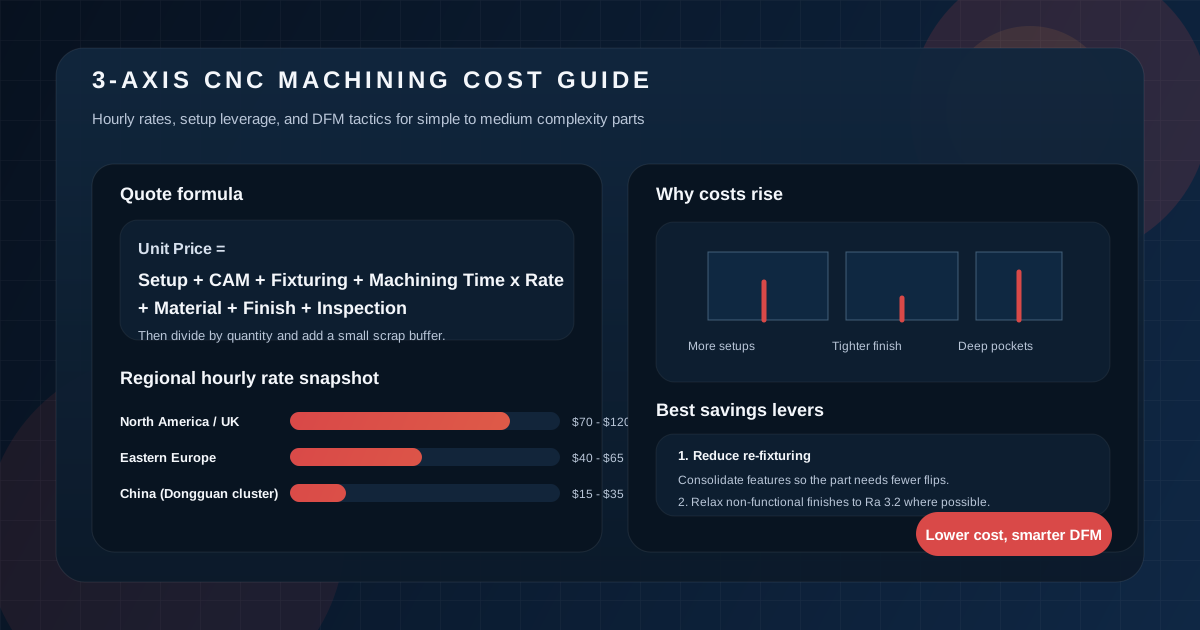
The table below is a practical benchmark for budget planning, not a universal list price. It is useful when comparing quotes across regions and understanding why one supplier can look dramatically cheaper on paper.
| Region | Avg. 3-Axis Hourly Rate (USD) | Setup and Programming Fee | Manufacturing Ecosystem Advantage |
|---|---|---|---|
| North America / UK | $70 - $120 / hr | $100 - $300 | High localized compliance, strong documentation, suitable for regulated prototypes |
| Eastern Europe | $40 - $65 / hr | $80 - $200 | Good engineering talent and close European logistics, but cost can move with energy and labor pressure |
| China (Dongguan cluster) | $15 - $35 / hr | $50 - $120 | Dense raw material supply, 24/7 production potential, and fast post-processing coordination |
The reason Dongguan can price aggressively is not just labor. It is supply chain compression.
When a shop can source 6061 aluminum stock nearby, machine it in-house, then send it directly to a local anodizing partner without cross-border or cross-country transfer, the hidden overhead drops. That does not automatically mean lower quality. It means fewer handoff losses, less idle time, and a cleaner quote structure.
For a buyer comparing routes, the most relevant question is this: does the supplier have the ecosystem to convert a drawing into a finished part with minimal delay?
3. The 3-Axis Core Limitation: How Setup Shifts Drive Your Costs Up
3-axis machines cut from one direction at a time along X, Y, and Z. That is efficient for prismatic parts, but it becomes expensive when the geometry demands access from multiple sides.
If a part has features on all six faces, the machine cannot magically reach every surface in one go. The operator may need to remove the part, flip it, re-indicate it, and re-zero the setup. That is re-fixturing, and it is one of the biggest hidden cost drivers in 3-axis machining.
Each additional setup usually adds:
- operator time
- machine idle time
- workholding handling
- re-alignment risk
- tolerance stack-up risk
The problem is not just the extra minutes. It is the accumulated error. Every time a part is re-clamped, a small amount of variation can enter the process. On a simple part, that may be acceptable. On a tight-tolerance assembly, it can become expensive fast.
This is why one apparently “simple” cube with holes on every face can quote much higher than expected. You are not paying for the cube. You are paying for the number of times the shop must treat the cube as a new job.
4. 4 Rigid DFM Cost-Reduction Rules for 3-Axis Parts
This is the part engineers usually save. If you want lower cost, you do not start with a negotiation. You start with the drawing.
Rule 1. Avoid Sharp Internal Corners
3-axis end mills are cylindrical. That means they cannot produce a perfect 90-degree internal corner. If a drawing insists on a sharp internal corner, the shop may need a secondary process such as EDM or a special finishing routine, which increases cost.
Practical rule:
- make the internal radius at least 1.3 times the cutter radius
- for a 6 mm tool, an internal R4 is usually a more realistic target than a sharp corner
This is also a strong reason to review your design before sending the RFQ. If the corner is not functional, let the radius do its job and save the budget for a feature that matters.
Rule 2. Limit Cavity Depth to About 4x Diameter
Deep narrow pockets are expensive because long-reach tools vibrate more easily. Once tool overhang gets long, deflection rises, chip evacuation gets worse, and the machinist often has to slow down the feed and reduce the depth of cut.
Practical rule:
- keep pocket depth below roughly 4x the tool diameter when possible
If the pocket must be deeper, expect more cycle time and possibly more tooling cost. This is where a supplier’s experience matters. A good shop will tell you whether the pocket is truly functional or whether it can be opened up without hurting performance.
Rule 3. Standardize Tapped Hole Depth
Deep threaded holes do not always add value. Past a certain point, more thread engagement does not materially improve performance, but it can increase tap breakage risk and cycle time.
Practical rule:
- a thread depth around 2x diameter is often enough for strong engagement in many aluminum and steel parts
- only go deeper when the load case really requires it
If you are buying repeat parts, standardizing thread depth across the drawing can also make programming and inspection easier.
Rule 4. Consolidate Surface Roughness Notes
One of the easiest ways to inflate a quote is to label every surface with the tightest finish.
Practical rule:
- keep tight Ra only on functional faces
- allow non-contact faces to relax to Ra 3.2 when the application permits
Why this matters: a blanket Ra 0.8 callout often forces slower finishing passes across the entire part. That slows the machine down without improving performance where it does not matter.
For roughness context, ISO’s surface texture standards define the parameters used in engineering drawings. The exact standard family evolves over time, but the underlying point is stable: the finish number on your print directly affects machining time. See the ISO reference in the links section at the end.
A Simple 3-Axis Saving Formula
If you want a buyer-friendly formula for cost control, use this one:
Estimated Unit Price = (Setup + CAM Programming + Fixturing + Machining Time x Hourly Rate + Material + Finishing + Inspection + Scrap Buffer) / Quantity
Or, if you want the DFM view:
Savings Potential = Re-fixturing Reduction + Toolpath Simplification + Finish Rationalization + Batch Amortization
The second formula is not a formal accounting model. It is a decision model. It helps you see where the quote is really coming from.
5. Batch Size ROI for 3-Axis: Why 100+ Parts is the Sweet Spot
3-axis machining is very sensitive to fixed cost. CAM programming, fixture preparation, machine setup, and first-part inspection are not fully proportional to quantity. That means the unit price can drop sharply when you move from one prototype to a small batch.
Here is a simplified example for a moderate-complexity aluminum part:
| Quantity | Setup Cost Amortized | Machining and Material | Total Price Per Part |
|---|---|---|---|
| 1 pc (Prototype) | $80.00 | $35.00 | $115.00 |
| 50 pcs | $1.60 | $28.00 | $29.60 |
| 500 pcs | $0.16 | $22.00 | $22.16 |
The lesson is simple: the first part is always the most expensive part.
Once the design stabilizes and the shop can reuse the same fixturing logic, the per-part price falls quickly. This is why high-mix, low-volume buyers often benefit from small batching. Even if you only need 12 or 25 units today, it may still be worth grouping the order with future demand if the geometry and delivery plan allow it.
For buyers working on aluminum housings, brackets, or support frames, the best combination is often:
- standard stock size
- accessible geometry
- moderate tolerances
- realistic finish requirements
- enough quantity to amortize setup
If your project also needs finishing, comparing surface finishing services early can keep the total cost under control. A part that looks cheap in raw machining can become expensive after finishing if the process stack is not planned in advance.
6. Conclusion and the Dongguan Speed Action Plan
3-axis machining is mature technology, which is exactly why cost optimization is so design-dependent. The machine itself is not the mystery. The mystery is whether the drawing makes the machine do unnecessary work.
If you want lower cost, focus on the features that drive setup count, tool reach, finish time, and inspection complexity. In practice, that means:
- fewer re-fixturing events
- no unnecessary sharp internal corners
- sane cavity depth
- standard thread depth
- selective roughness callouts
At Huade Precision, we are set up for this kind of buying workflow. Our team in Dongguan can review your STEP files, flag high-cost geometry, and propose a cleaner route for 3-axis CNC milling, aluminum machining, and follow-on finishing. If your project is still in the early quote stage, you can also use our CNC material selector to narrow the material first.
Need a reliable 3-axis CNC partner who understands margins?
Send us your STEP files today through the quote page or contact our engineering team. We will review the design, identify avoidable setups, and give you a lean, transparent quote within 24 hours.