If you have ever sent the same 5-axis CNC part to three suppliers and received three quotes that were nowhere near each other, you are not imagining things. One factory may quote $480, another $900, and a third more than $1,400 for the same prototype. For a procurement manager, that spread feels less like engineering and more like a black box.
This guide opens that box. It explains how 5-axis CNC machining cost is usually calculated in 2026, what hourly rates look like across major sourcing regions, and which drawing choices quietly make parts expensive. Read it like a buyer’s map: not every number will match every shop, but the logic will help you challenge a quote, compare suppliers, and lower cost without weakening the part. For a broader capability view, see Huade’s custom CNC machining services and CNC milling service.
1. Introduction: Why 5-Axis Machining Quoting Seems Like a “Black Box”
5-axis machining quotes vary because the supplier is pricing more than cutting time. They are pricing engineering judgment, CAM programming, collision simulation, fixture strategy, machine availability, tool reach, inspection risk, material waste, finishing control, and the chance that the first part will need adjustment before it passes inspection.
A simple multi-face aluminum CNC machining bracket may run on a 3+2 positioning strategy with moderate programming time. A thin-walled titanium CNC machining medical part, a deep-pocket aerospace housing, or an impeller with simultaneous 5-axis surfacing demands much more engineering attention. On paper, both are “5-axis CNC parts.” In the shop, they behave like different animals.
The buyer’s job is not to memorize every machine parameter. It is to understand where the quote comes from and what information helps a capable supplier price the job cleanly.
2. The Core Formula: How 5-Axis CNC Quotes Are Calculated
Most serious 5-axis CNC quotes follow a version of this formula:
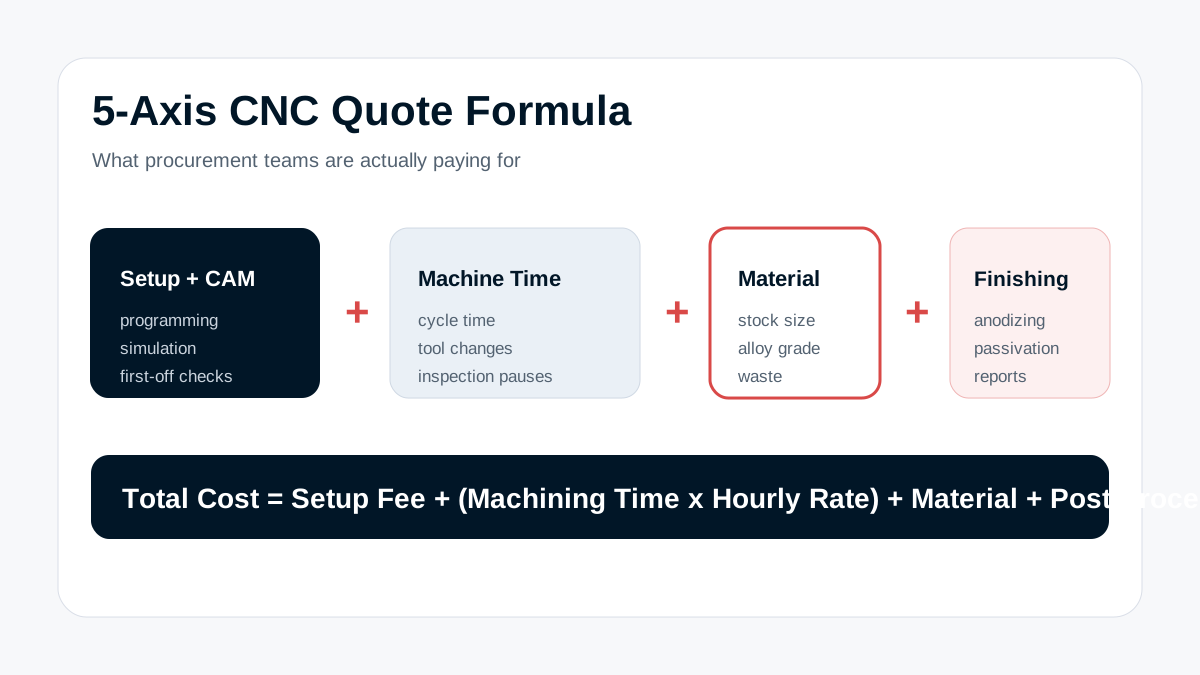
Total Cost = Setup & Programming Fee + (Machining Time x Hourly Rate) + Material Cost + Post-Processing
That looks simple, but each term carries real manufacturing work.
Setup and Programming Fee
For 5-axis projects, setup and programming fees are often higher than 3-axis work. A realistic range for many prototype or low-volume jobs is $100-$500, while complex aerospace-style parts may go higher. The reason is not mystery pricing. A CAM engineer must define tool orientation, collision limits, fixture clearance, safe retracts, cutter length, surface strategy, and inspection datums before the machine cuts anything.
Advanced CAM systems such as hyperMILL, Mastercam, PowerMill, or equivalent platforms help with simulation, but software does not remove engineering time. It makes that time more reliable. Mastercam’s multiaxis documentation, for example, emphasizes tool-axis control, collision avoidance, gouge checking, and safe-zone control, which are exactly the programming tasks that make 5-axis setup more expensive than basic 3-axis milling.
Machining Time
Machining time includes more than the tool touching metal. It can include probing, tool changes, roughing, semi-finishing, finishing, deburring pauses, and in-process checks. A part with a beautiful CAD model but deep narrow cavities may look small on screen while still consuming hours on a 5-axis machine.
Hourly Rate
The hourly rate is the shop’s charge for machine capacity, operator labor, programming support, depreciation, maintenance, electricity, tool wear, quality overhead, and profit. This is where regional differences become obvious.
Material and Post-Processing
Material is not only the final part weight. Buyers pay for stock size, minimum order quantity from material suppliers, yield loss, and certification when required. Post-processing includes anodizing, hardcoat anodizing, passivation, polishing, bead blasting, plating, heat treatment, cleaning, special packaging, and inspection reports.
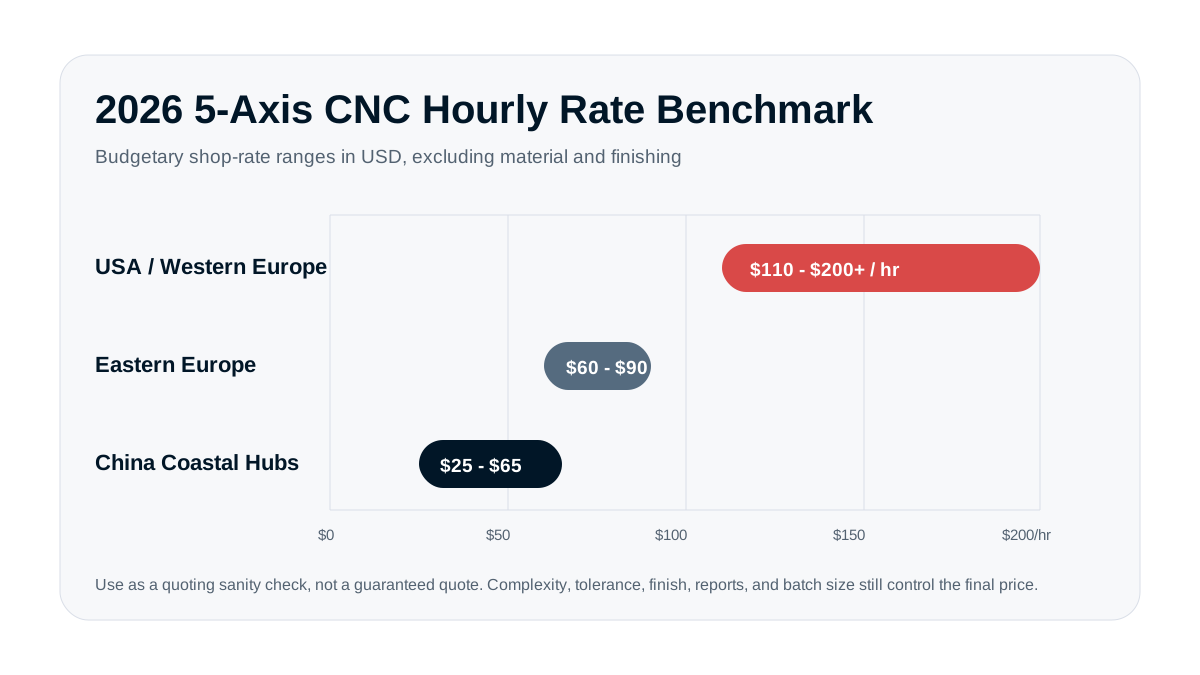
3. 2026 Global Benchmark: 5-Axis CNC Hourly Rates by Region
The table below is a procurement benchmark, not a universal price list. It reflects common 2026 budgetary ranges seen in RFQ comparisons for industrial 5-axis CNC work, excluding material, finishing, and special certification.
| Region | Avg. 5-Axis Hourly Rate (USD) | Typical Setup Fee | Key Cost Drivers |
|---|---|---|---|
| USA / Western Europe | $110-$200+ / hr | $300-$1,000 | High specialized labor cost, high overhead, strict compliance workload |
| Eastern Europe | $60-$90 / hr | $200-$500 | Rising energy cost, localized compliance, smaller supplier clusters |
| China (Coastal Hubs) | $25-$65 / hr | $100-$250 | Mature manufacturing clusters, high machine utilization, multi-shift production |
China’s advantage is often misunderstood. A lower 5-axis hourly rate does not automatically mean lower quality. In coastal manufacturing hubs such as Dongguan, the surrounding ecosystem is dense: aluminum and stainless stock suppliers, carbide tool distributors, heat treatment partners, anodizing shops, passivation vendors, inspection resources, and logistics providers are all close enough to reduce waiting time and handling cost.
Huade Precision is located in Dongguan, one of the world’s most mature manufacturing centers. That position lets us connect directly with raw material and post-processing supply chains such as hard anodizing, passivation, polishing, and plating, which helps avoid unnecessary broker layers and keeps quote structure more transparent. Buyers can also compare related in-house pages for metal CNC machining, surface finishing services, and quality inspection.
Another factor is machine utilization. Many Chinese CNC factories run multi-shift schedules, sometimes close to 24/7 for urgent or stable production programs. Higher utilization spreads machine depreciation across more working hours, which lowers the hourly burden on each part.
4. Top 3 Hidden Cost Drivers in 5-Axis Machining
Here is where buyers can save real money. The most expensive detail is often not the largest surface; it is the small drawing note that forces the supplier into a slower process.
3+2 Positioning vs. 5-Axis Simultaneous
Many parts marketed as “5-axis” do not require all five axes to move at the same time. If the machine only needs to index the part to a fixed angle and then cut with normal 3-axis motion, the process is called 3+2 machining or positional 5-axis machining. It is stable, efficient, and often cheaper. Autodesk’s machining resources make the same distinction between 3+2 positional work and simultaneous 5-axis motion, a useful reference point when a supplier quotes a premium multi-axis strategy.
True simultaneous 5-axis machining is useful for impellers, blades, complex organic surfaces, and tool-axis-controlled finishing, but it raises programming difficulty and machine-time cost. A good supplier should tell you when 3+2 is enough. Paying for simultaneous motion when the geometry does not need it is like renting a race car to deliver office mail. If your part is mainly cylindrical with milled flats or cross holes, CNC turning and mill-turn support may be the more economical route.
Unnecessary Surface Finish Requirements
Surface roughness notes can double your machining time. A drawing that demands Ra 0.4 um across large non-sealing surfaces may force the supplier into smaller stepovers, slower feed rates, finer tools, and longer finishing cycles. If the surface is cosmetic or non-functional, Ra 1.6 um may be a better default target, followed by sandblasting, anodizing, polishing, or other finishing as needed. For background, ISO surface texture standards such as ISO 4287 define roughness parameters including Ra, which is why the number on a drawing has real machining consequences.
Keep tight roughness where it matters: sealing faces, bearing interfaces, sliding surfaces, optical contact areas, and fluid-control zones. Relax it where the part only needs clearance or appearance.
Deep and Narrow Cavities
Deep pockets and narrow slots force long tool overhang. Long tools are flexible. Flexible tools chatter, deflect, and leave poor surface finish unless the machinist lowers the cutting speed and takes lighter passes. Sandvik Coromant’s guidance on vibration in metal cutting points to long overhangs and deep cavities as classic stability problems. That slow-down goes directly into machining time.
Design relief radii, open pockets, larger corner radii, and practical tool access can reduce cost without changing the part’s purpose. If the cavity is unavoidable, mention which features are functional so the supplier can protect the right dimensions instead of over-finishing every wall.
5. FAQ: Why Is 5-Axis Machining So Expensive?
5-axis machining is expensive when the part needs heavy CAM programming, collision simulation, high-end machine capacity, long-reach tooling, tight surface finish, complex inspection, or simultaneous multi-axis motion. The machine itself costs more to buy and maintain, while skilled programmers and operators are harder to find than standard milling labor.
That said, 5-axis machining can still lower total project cost. It reduces fixtures, cuts re-clamping error, shortens process routes, and can prevent scrap on parts where 3-axis machining would require multiple risky setups. The trick is to use 5-axis capability where it removes cost, not where it merely sounds premium.
6. Case-Style Pricing: 1 Prototype vs. 1,000 Batch Run
Volume changes the math because setup and programming are fixed costs. A single prototype carries the whole engineering burden. A batch spreads that burden across many parts, and the supplier can optimize tooling, fixture flow, and inspection frequency.
The example below uses a simplified aluminum 6061 or 7075 multi-face bracket with moderate tolerance and anodizing excluded. Treat it as a pricing model, not a guaranteed quote. If you are comparing aluminum grades, Huade’s aluminum CNC machining page is a useful next stop.
| Quantity | Setup & Programming (Fixed) | Material & Machine Time (Per Part) | Total Project Cost | Final Per-Part Price |
|---|---|---|---|---|
| 1 Unit (Prototype) | $200 | $260 | $460 | $460.00 / pc |
| 10 Units | $200 | $230 | $2,500 | $250.00 / pc |
| 1,000 Units | $200 | $45 | $45,200 | $45.20 / pc |
The lesson is simple: five-axis prototypes can feel expensive because the fixed work has nowhere to hide. Once the design stabilizes and the supplier can build a repeatable route, per-part pricing falls quickly.
For stainless steel, titanium, Inconel, or thin-wall parts, the same pattern applies, but the per-part machining cost will usually stay higher because cutting speed, tool wear, and deformation risk are less forgiving.
7. How to Get an Accurate 5-Axis CNC Quote Within 24 Hours
Fast quotes are possible when the RFQ package is complete. Slow quotes usually happen because the supplier must guess, ask follow-up questions, or protect themselves with a high risk buffer.
Send these items when possible:
- A clean 3D CAD file in STEP, IGES, X_T, or native SolidWorks format.
- A 2D PDF drawing with tolerances, datums, threads, surface roughness, and critical-to-quality notes.
- Exact material grade, such as Aluminum 7075-T6 instead of simply “aluminum.”
- Surface treatment requirements, including anodizing, hardcoat anodizing, passivation, bead blasting, polishing, plating, painting, or heat treatment.
- Quantity, target lead time, annual forecast, and whether the order is prototype, pilot batch, or production.
- Inspection requirements such as CMM report, material certificate, FAI/FAIR, PPAP, or custom incoming-QC format. See Huade’s quality control and inspection capability for the typical metrology context.
When you are unsure about a tolerance or finish, mark it as negotiable. That small note gives the engineering team permission to suggest a cheaper route.
8. Practical Saving Tips Before You Send the RFQ
Keep the model clean. Remove cosmetic fillets that do not affect function, especially in deep internal corners.
Separate functional surfaces from cosmetic surfaces. Your supplier should not have to guess whether a shiny wall is a bearing datum or just a visible face.
Use standard stock thicknesses and common alloys when the application allows it. 6061-T6 is generally easier and cheaper than 7075-T6; stainless 303 machines faster than 316 but may not match the corrosion requirement; titanium should be used for real weight, strength, or biocompatibility reasons, not because it sounds premium. For early material screening, try the CNC material selector.
Ask whether 3+2 positioning can replace simultaneous 5-axis motion. This single question can reveal whether the supplier is thinking like an engineer or simply quoting machine prestige.
Do not hide the target budget. A practical supplier can often propose a design or tolerance adjustment that protects function while bringing the price closer to your target.
9. Conclusion: Stop Guessing Your Manufacturing Costs
5-axis CNC machining costs more when the part demands sophisticated programming, slow finishing, long tools, difficult material, or strict inspection. It costs less when the design gives the supplier clear datums, practical tool access, realistic surface finish, and enough quantity to spread setup work.
Send us your STEP files today. Huade Precision’s engineering and quoting team will run your design through our 2026 DFM matrix and provide a transparent, line-item 5-axis CNC quote within 24 hours, completely free of charge. You can also contact our engineers if you want to discuss tolerance, material, or finishing options before submitting the full RFQ.
Get a transparent 5-axis CNC quote