Deburring CNC machined aluminum is not just a finishing detail. It affects assembly fit, handling safety, anodizing quality, cosmetic acceptance, fatigue risk, and total part cost. A tiny burr on a hole, slot, pocket wall, or machined edge can prevent a fastener from seating, scratch a mating component, trap finishing media, or create a sharp edge that fails incoming inspection.
For buyers sourcing custom aluminum CNC machining, the best approach is not to “machine first and fix the burrs later.” Burr control should start with material selection, toolpath planning, cutter geometry, edge-break specifications, finishing selection, and inspection criteria.
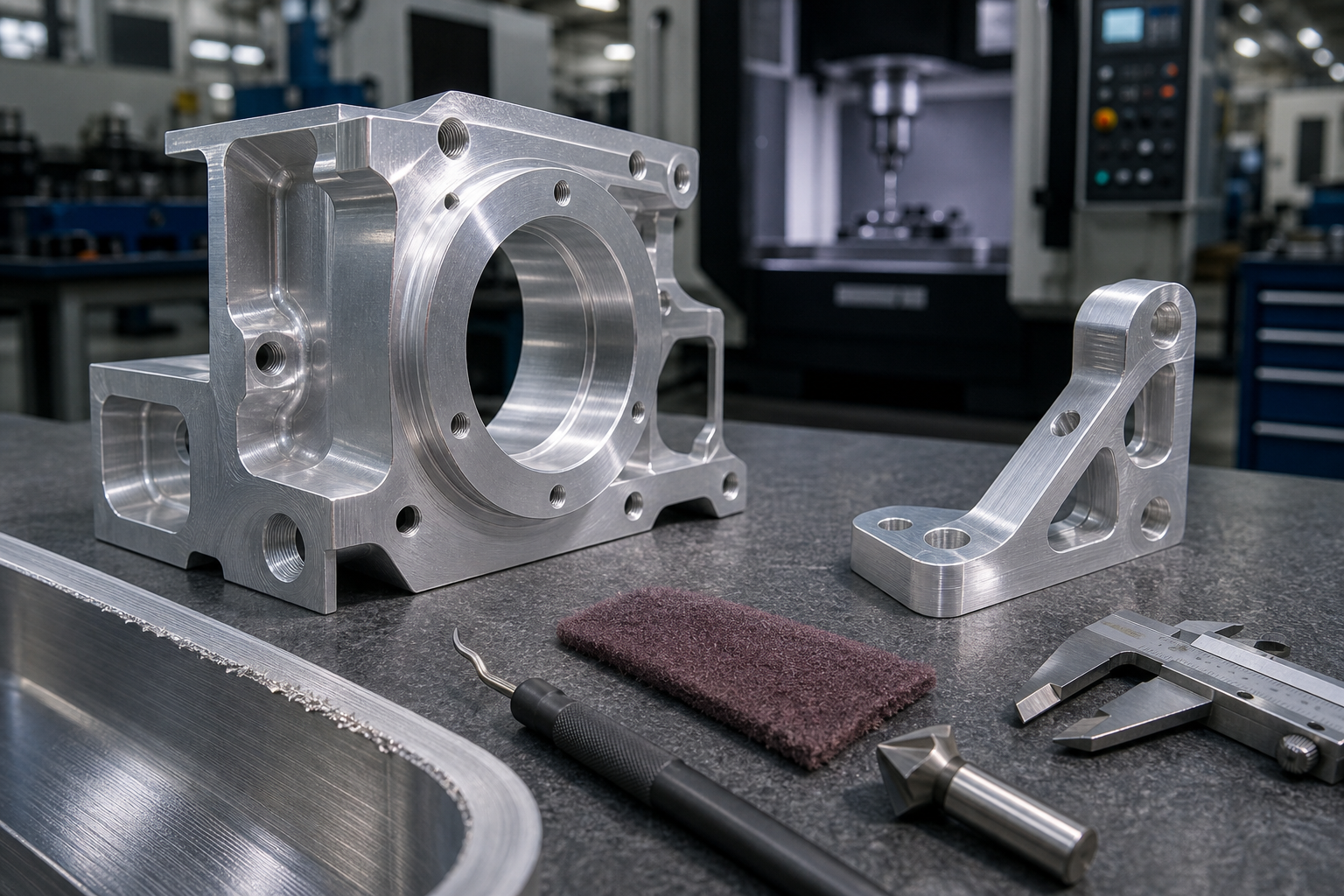
This guide explains how burrs form on CNC machined aluminum, how to reduce them during machining, which deburring methods work best, and how to specify edge quality clearly when sending an RFQ.
Quick Answer: What Is Deburring CNC Machined Aluminum?
Deburring CNC machined aluminum means removing unwanted raised material, sharp edges, feather edges, rollover, or small metal projections left after milling, turning, drilling, tapping, sawing, engraving, or threading aluminum parts. The goal is to create safe, functional, repeatable edges without damaging dimensions, cosmetic surfaces, threads, bores, sealing faces, or anodizing quality.
For most aluminum CNC parts, deburring is handled through a combination of:
- Controlled machining parameters that reduce burr formation
- Chamfers, edge breaks, or radii added in the CNC program
- Manual deburring for critical or cosmetic edges
- Tumbling, vibratory finishing, brushing, blasting, or polishing for broader edge smoothing
- Inspection to confirm that functional edges remain clean and dimensions stay within tolerance
If the part is made from 6061, 7075, 5052, 6063, or another aluminum alloy, the deburring route should be reviewed together with the main aluminum CNC machining process. That is especially important for visible housings, drone parts, robotics brackets, electronics enclosures, heatsinks, audio parts, and parts that will be anodized.
Why Burrs Matter On Aluminum CNC Parts
Aluminum is widely used because it machines quickly, offers a strong strength-to-weight ratio, and supports attractive finishes. But those same machining advantages can create burr challenges if the process is not controlled.
Burrs matter because they can cause:
- Assembly interference: A burr around a hole or pocket can stop a mating part from seating flat.
- Thread problems: Burrs at tapped holes can damage screws or create inconsistent torque.
- Handling risk: Sharp aluminum edges can cut operators, packaging, cables, or seals.
- Finish defects: Burrs can break off during bead blasting, anodizing, polishing, or cleaning.
- Cosmetic rejection: Feathered or uneven edges look poor on consumer-facing products.
- Inspection disagreement: If the drawing only says “remove burrs,” suppliers and buyers may interpret acceptable edge condition differently.
In precision aluminum machining, deburring is part of manufacturability, not a separate afterthought.
Common Burr Locations In CNC Machined Aluminum
Burrs do not appear randomly. They usually form where the cutting tool exits the material, where chip evacuation is poor, or where the edge lacks support during the final cut.
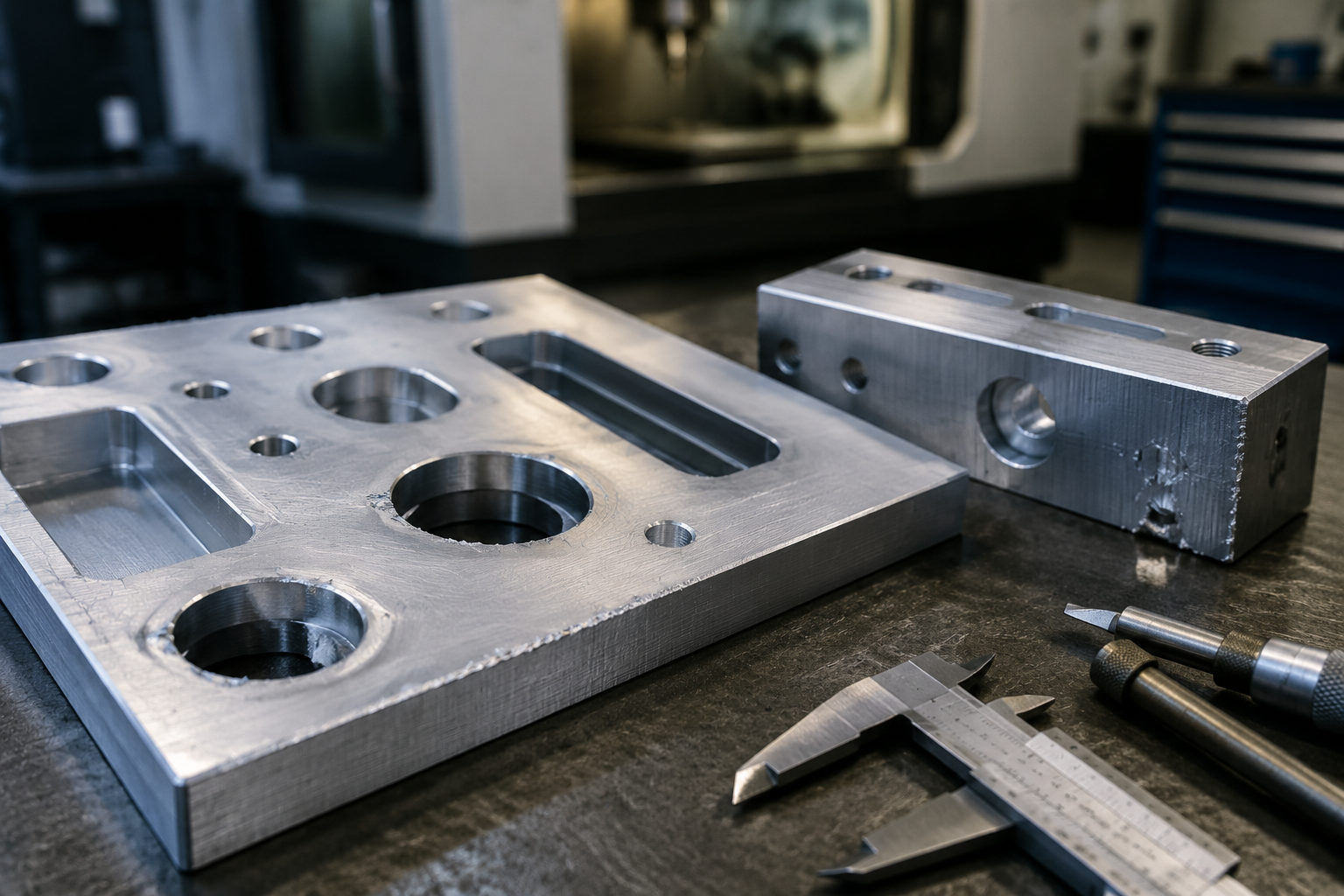
Common locations include:
| Feature | Burr risk | Practical concern |
|---|---|---|
| Drilled holes | Burrs on entry and exit edges | Fastener seating, seal damage, thread start quality |
| Milled pockets | Feather burrs on top edges and internal corners | Cosmetic appearance, cleaning, anodizing consistency |
| Thin walls | Rollover or deformation | Part distortion, weak edges, visual defects |
| Cross holes | Hidden internal burrs | Flow restriction, cable abrasion, assembly failure |
| Slots and keyways | Raised side burrs | Fit problems with mating tabs or keys |
| Turned grooves | Sharp lips or curled burrs | O-ring damage, bearing fit problems |
| Threaded holes | Burrs at lead-in or thread exit | Screw galling, torque variation |
The harder the edge is to reach, the more important it is to prevent burrs during machining. Cross holes, deep internal channels, small grooves, and miniature features can be difficult or impossible to clean manually after the part leaves the fixture.
Why Aluminum Forms Burrs During CNC Machining
Aluminum alloys are generally easier to cut than stainless steel or titanium, but burr formation depends on alloy, temper, cutter sharpness, toolpath direction, feed, speed, workholding rigidity, and feature geometry.
The most common causes are:
1. Dull Or Improper Cutting Tools
A sharp tool shears aluminum cleanly. A worn tool pushes, smears, or tears material. This is one of the fastest ways to create large burrs and poor surface finish. For aluminum, polished carbide tools, suitable rake geometry, and good chip clearance help reduce built-up edge and smearing.
2. Poor Chip Evacuation
Aluminum chips can pack into pockets, slots, and deep holes. If chips are recut, they scratch surfaces and create secondary burrs. Proper coolant, air blast, flute design, and toolpath strategy help move chips away from the cutting zone.
3. Exit Burrs From Drilling And Milling
When a drill or end mill exits a surface, the remaining material may bend before it fractures. This creates exit burrs. Backup support, peck drilling, optimized feed near breakthrough, and secondary chamfer operations can reduce this risk.
4. Aggressive Feed Or Unstable Workholding
High productivity is one reason aluminum is attractive, but unstable cutting can create chatter, edge tearing, and inconsistent burrs. Thin-wall aluminum parts are especially sensitive because they can vibrate or deflect under cutting forces.
5. Geometry That Forces Burr Formation
Sharp outside corners, thin unsupported edges, intersecting holes, deep slots, and very small features often produce burrs unless the design includes an edge break or the process includes a planned deburring operation.
How To Reduce Burrs Before Deburring
The cheapest burr is the one that never forms. A strong aluminum CNC machining supplier will look for prevention opportunities before choosing a finishing method.
Use Sharp Tools Designed For Aluminum
Aluminum machining benefits from tools with sharp cutting edges, proper rake, polished flutes, and chip space. Two-flute or three-flute end mills are common for aluminum because they provide chip clearance. For some high-volume face milling operations, engineered cutters are designed specifically to improve surface quality and reduce burring.
Add Designed Edge Breaks
Instead of leaving edge condition vague, call out an edge break such as:
- Break sharp edges 0.1-0.3 mm
- Chamfer 0.2 x 45 degrees unless otherwise specified
- Critical sealing edge: no burrs, no nicks, max edge break 0.05 mm
- Cosmetic edge: uniform hand-debur, no visible rollover
These notes help the machinist protect critical features and avoid over-deburring.
Adjust Toolpath Direction
Climb milling, conventional milling, cutter exit direction, and final pass strategy can all affect burr direction and size. A small finishing pass may produce cleaner edges than leaving heavy stock for the final cut.
Use In-Machine Chamfering
For repeatable parts, adding chamfering directly in the CNC setup is often more consistent than relying only on hand finishing. In-machine chamfering is especially useful for holes, pocket edges, slots, and visible external profiles.
Keep Thin Walls Supported
Thin aluminum features need stable workholding and staged material removal. If a wall flexes during cutting, burrs and edge distortion become more likely. This matters for UAV components, electronics housings, lightweight brackets, and energy-storage enclosures.
Deburring Methods For CNC Machined Aluminum
No single deburring method is best for every aluminum part. The right choice depends on geometry, tolerance, cosmetic requirements, quantity, finish, and edge accessibility.
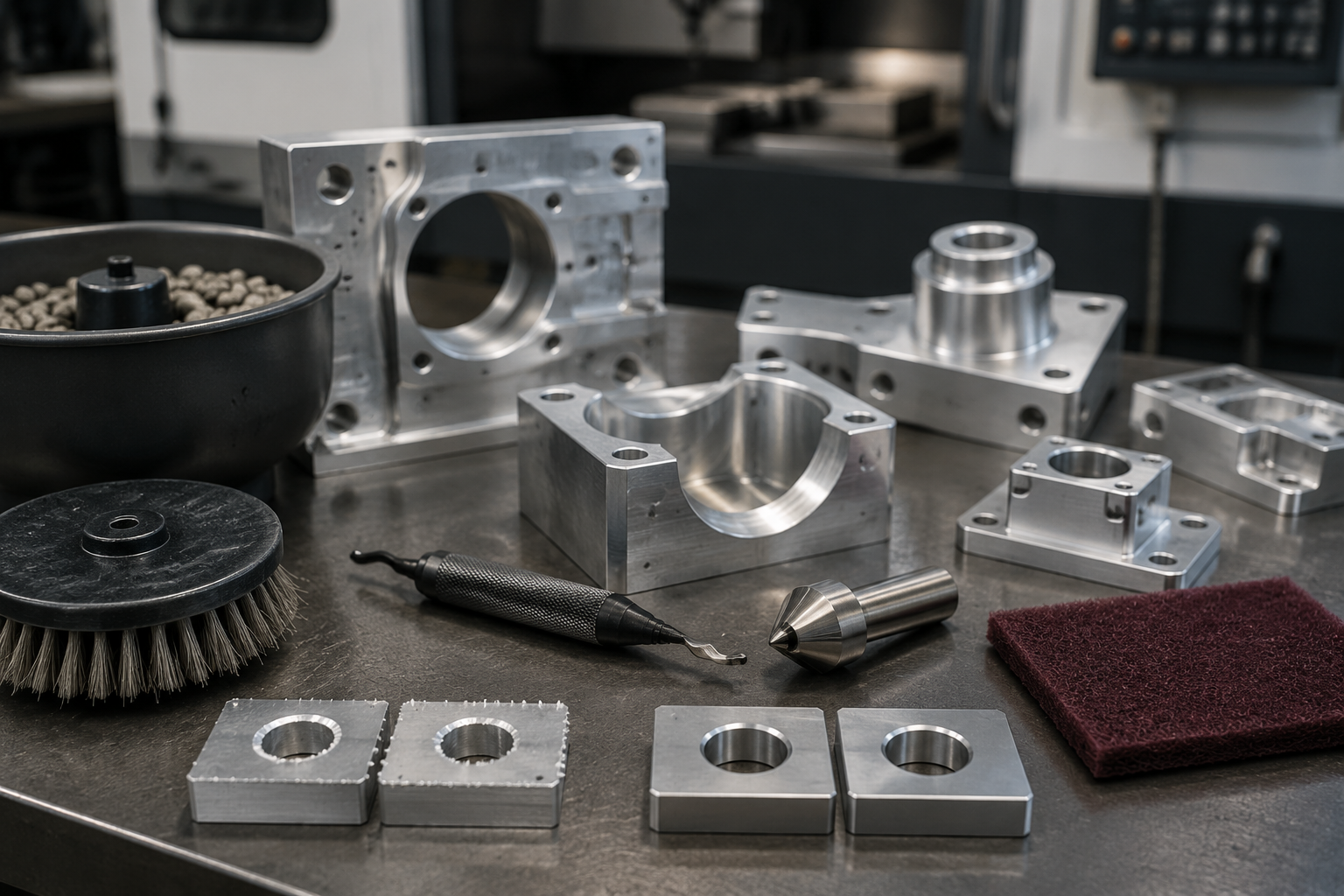
Manual Deburring
Manual deburring uses hand tools, blades, scrapers, files, abrasive pads, or small rotary tools. It is flexible and useful for prototypes, small batches, cosmetic faces, and critical edges.
Best for:
- Prototype and low-volume aluminum parts
- Selective edge control
- Visible components where a trained operator can protect surfaces
- Edges that need judgment rather than bulk processing
Main caution: manual deburring can vary between operators. If the edge is critical, specify the edge break dimension and inspection method.
In-Machine Deburring And Chamfering
This method uses the CNC machine to cut chamfers, countersinks, or edge breaks before the part is removed from the fixture. It improves repeatability and can reduce secondary labor.
Best for:
- Production aluminum parts
- Hole edges, slot edges, and external profiles
- Features that are accurately located from the original setup
- Parts where repeatability matters more than hand blending
Main caution: tool access is required. Deep internal edges or complex cross holes may still need other methods.
Vibratory Finishing Or Tumbling
Vibratory finishing uses media, compound, water, and motion to smooth edges across many parts at once. It is efficient for small aluminum components where uniform edge softening is acceptable.
Best for:
- Small brackets, spacers, washers, fittings, and turned parts
- Batch deburring
- Non-cosmetic edges or parts that will receive additional finishing
- Parts where slight edge rounding is acceptable
Main caution: tumbling can soften edges, alter cosmetic faces, and affect tight dimensions. Avoid it for fragile thin walls or sealing surfaces unless tested.
Brushing
Abrasive nylon brushes, wire brushes, or specialized CNC brushing tools can remove light burrs from faces and edges. Robotic or in-machine brushing can be useful in production.
Best for:
- Light burrs on machined faces
- Repeating features
- Soft metals such as aluminum and brass
- Production parts where process consistency is important
Main caution: brushing may not remove heavy rollover burrs, especially on unsupported or hidden edges.
Bead Blasting And Sandblasting
Blasting can smooth minor edges and create a uniform matte texture. It is commonly used before anodizing visible aluminum parts. However, blasting should not be treated as the only solution for heavy burrs.
Best for:
- Cosmetic aluminum housings
- Matte appearance before anodizing
- Hiding fine machining marks
- Parts where all exposed surfaces need a consistent texture
Main caution: heavy burrs should be removed first. Blasting a burr can fold, fracture, or leave inconsistent edges. Review Huade’s surface finishing services when the part needs both machining and cosmetic finishing.
Polishing
Polishing removes fine machining marks and can soften edges, but it is labor-intensive and removes material. It is used for decorative parts, premium hardware, optical-adjacent components, and visible aluminum surfaces.
Best for:
- High-gloss aluminum components
- Premium cosmetic parts
- Visible audio, consumer, or hardware components
- Surfaces requiring reduced roughness
Main caution: polishing can round sharp features and change dimensions. If the part needs both clean edges and precise fits, discuss the polishing allowance during RFQ.
Abrasive Flow Or Specialized Internal Deburring
Internal channels, manifolds, cross holes, and complex flow paths may need specialized methods. Abrasive flow machining or controlled internal brushing can reach areas that hand tools cannot.
Best for:
- Internal passageways
- Fluid or pneumatic components
- Cross-drilled holes
- Parts where loose burrs could break free during service
Main caution: this is not always economical for simple parts. It should be specified only when internal burr removal is function-critical.
Deburring Before Anodizing Aluminum
Deburring is especially important when aluminum parts will be anodized. Anodizing does not hide poor edge condition. In many cases, it makes inconsistent edges more visible.
Before anodizing aluminum CNC parts, check:
- Are all sharp edges broken consistently?
- Are cosmetic faces protected from hand-tool scratches?
- Are burrs removed before bead blasting?
- Are threaded holes clean enough to avoid trapped media or chemical residue?
- Are masking areas and contact points defined?
- Has coating thickness been considered for tight fits?
For cosmetic aluminum parts, the best sequence is often machining, controlled deburring, bead blasting or surface preparation, cleaning, anodizing, and final inspection. The exact route depends on alloy, color, surface texture, and function.
How To Specify Deburring On A Drawing
Many drawings use generic notes such as “remove all burrs” or “break sharp edges.” These are better than nothing, but they can still create confusion.
For custom aluminum CNC machining, clearer notes include:
| Drawing note | When to use |
|---|---|
| Remove burrs and sharp edges | General-purpose parts with non-critical edges |
| Break edges 0.1-0.3 mm unless otherwise specified | Most machined aluminum brackets and housings |
| Chamfer 0.2 x 45 degrees on all accessible edges | Repeatable CNC edge break |
| No burrs permitted in cross holes or internal passages | Fluid, pneumatic, cable, or precision assemblies |
| Cosmetic faces: no visible hand-tool scratches | Visible consumer or premium parts |
| Do not deburr sealing edge beyond 0.05 mm | Gasket, O-ring, or sealing surfaces |
The more functional the edge, the more specific the requirement should be. Over-deburring can be just as damaging as under-deburring when the edge controls sealing, alignment, bearing fit, or appearance.
Inspection Checklist For Deburred Aluminum Parts
Inspection should match the risk level of the part. A simple bracket may only need visual and touch checks. A sealing plate, optical mount, robotic joint component, or UAV fastener may need magnification, gauges, or dimensional verification after deburring.
Practical checks include:
- Visual inspection under proper lighting
- Fingernail or cotton swab check for sharp projections
- Thread gauge checks after tapping and deburring
- Pin gauge checks for holes that may be affected by burrs
- CMM or height gauge inspection for critical features
- Surface roughness checks where finish is specified
- Cosmetic inspection before and after anodizing or blasting
For higher-risk projects, Huade can review edge quality together with quality inspection requirements and the aluminum material page during the RFQ stage.
Deburring Cost: What Drives The Price?
Deburring cost is driven by time, access, consistency requirements, and risk. A simple external chamfer may add little cost if it is programmed into the CNC operation. A hidden internal burr in a cross-drilled hole can be much more expensive to remove and verify.
Cost increases when:
- The part has many edges, holes, slots, or cross features
- Burrs are hidden inside deep pockets or internal passages
- Cosmetic faces require hand protection
- The part is thin, fragile, or easily distorted
- Deburring must be done manually under magnification
- Tight tolerances must be protected after edge finishing
- The part requires bead blasting, anodizing, polishing, or multiple post-processes
The best cost-control strategy is to identify functional edges early. Not every edge needs the same standard. A hidden clearance edge can often use a normal break, while a sealing edge, thread start, bearing bore, or visible face may need tighter control.
Deburring Strategy By Aluminum Part Type
Different aluminum parts need different edge-quality strategies.
CNC Aluminum Housings And Enclosures
Housings usually need clean outside edges, cosmetic surfaces, and protected threaded holes. For anodized housings, burrs should be removed before surface preparation. See Huade’s aluminum CNC machining service for common enclosure materials such as 6061 and 6063.
Drone And UAV Aluminum Components
Lightweight 7075 aluminum parts often include thin walls, small holes, and structural edges. Burrs can affect assembly and damage carbon-fiber or polymer mating components. Edge breaks should be controlled without removing too much material.
Heat Sinks And Thermal Plates
Heat sinks may have fins that are easy to bend. Deburring must avoid distorting fins or reducing contact surface flatness. The contact face may need a different process from the outer perimeter.
Audio And Consumer Aluminum Parts
Visible aluminum parts need consistent hand finishing, bead blasting, polishing, or anodizing. A technically acceptable edge may still fail cosmetic inspection if the edge break is uneven.
Fluid Or Pneumatic Aluminum Components
Internal burrs are the main risk. Cross holes, ports, and threads must be clean enough to prevent debris, seal damage, or flow restrictions.
FAQ: Deburring CNC Machined Aluminum
What is the best way to deburr aluminum CNC parts?
The best method depends on the part. Manual deburring is flexible for prototypes and cosmetic parts. In-machine chamfering is more repeatable for production. Vibratory finishing is efficient for small batches of simple parts. Internal burrs may need specialized methods.
Does aluminum need deburring after CNC machining?
Usually, yes. Even well-machined aluminum parts often need at least a light edge break. Functional holes, slots, threads, and visible edges should be reviewed carefully.
Can anodizing cover burrs?
No. Anodizing does not fix burrs. It can make poor edge quality more obvious and may create inconsistent color or weak points if burrs break off after finishing.
What edge break should I specify for aluminum CNC parts?
For many general parts, 0.1-0.3 mm is a practical edge break range. Critical sealing edges, bearing fits, cosmetic surfaces, or miniature features may need a custom note.
Is tumbling good for aluminum?
Tumbling or vibratory finishing can work well for small aluminum parts, but it can round edges, affect cosmetic surfaces, and change sensitive dimensions. Test first for tight-tolerance or appearance-critical parts.
Conclusion: Good Aluminum Deburring Starts Before The First Cut
Deburring CNC machined aluminum is a quality-control decision, a cost-control decision, and a design-for-manufacturing decision at the same time. Clean edges come from the full process: alloy selection, cutter geometry, toolpath planning, workholding, chamfer strategy, finishing method, and inspection.
If your project includes aluminum housings, brackets, heat sinks, UAV parts, audio hardware, robotics components, or anodized aluminum parts, start with Huade’s custom aluminum CNC machining service. Send your CAD files, drawings, material grade, finish requirement, and edge notes, and our engineers can review the deburring route before production begins.